


Introduction
Right now, somewhere in your business, leads are leaking. A form submission came in at 9 PM and no one responded until 11 AM the next day — by which time the prospect had already booked with a competitor who called back within minutes. A missed call went to voicemail and was never returned. A website visitor asked a question in the chat widget, received no answer, and left. A prospect who downloaded a resource three weeks ago was never followed up with because it slipped through the cracks of a busy week.
None of these losses show up on a report. There is no invoice for the revenue that never materialized. There is no record of the client who chose someone else because the response was too slow. The leak is invisible — but it is constant, and the cumulative cost of it, month after month, is significant.
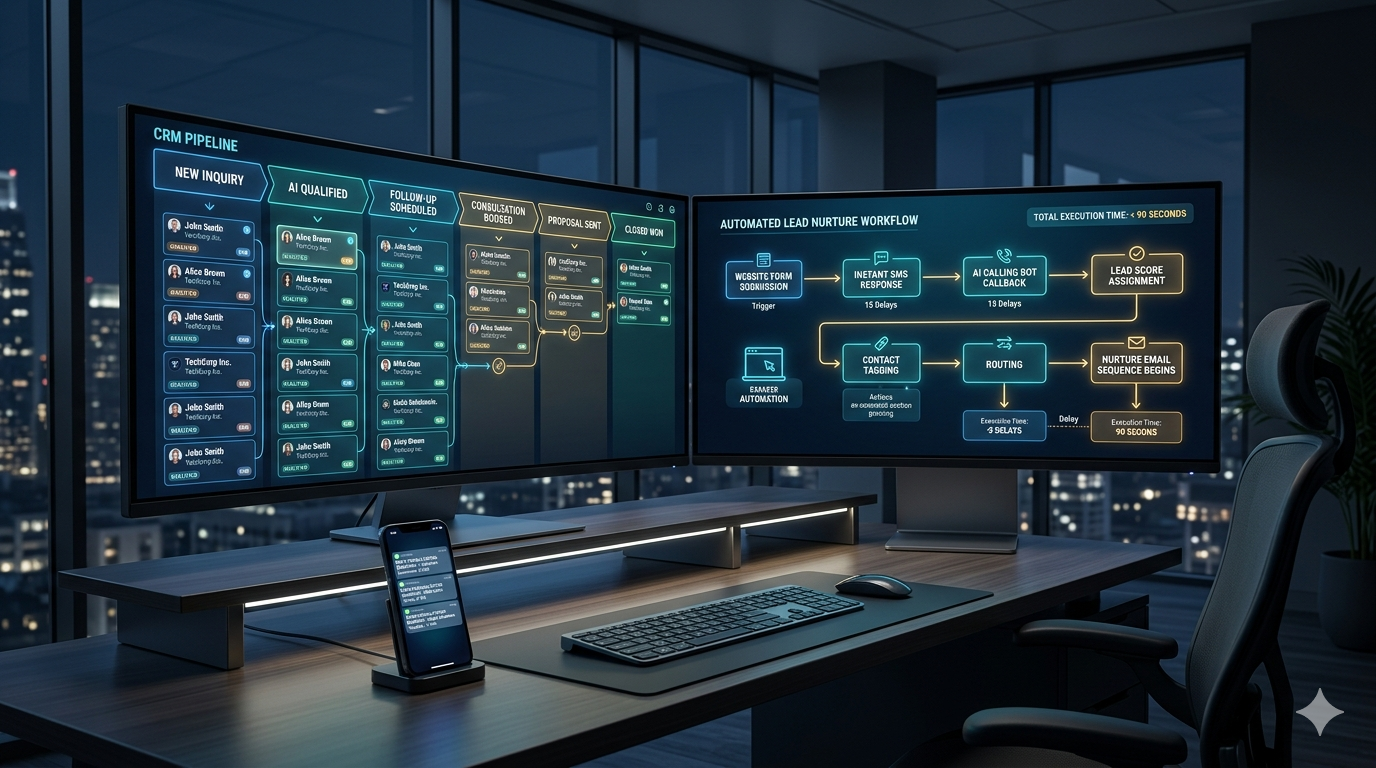
CRM combined with AI automation seals every one of these leaks. Not by working harder. Not by hiring more people. But by building a system that captures every inquiry the moment it arrives, responds within seconds regardless of the hour, qualifies leads automatically based on defined criteria, routes them to the right stage and the right sequence, and follows up persistently and intelligently until a conversion happens or the lead definitively opts out.
This is not a future capability. It is available now, deployable in weeks, and producing measurable results for the businesses that have built it. Here is exactly how it works — and why businesses that build it win leads that their competitors are losing every single day.
The Lead Capture Gap That Is Costing You More Than You Know
Before understanding the solution, the problem needs to be stated clearly — because most business owners significantly underestimate the scale of their lead capture gap.
Research on lead response time is consistent and unambiguous: the probability of converting a lead drops by over 80% if the first response takes longer than five minutes. A lead contacted within one minute of their inquiry is dramatically more likely to convert than one contacted an hour later. A lead contacted the next business day is, for practical purposes, cold.
Most businesses respond to leads in hours, not minutes. Many respond the next day. Some never respond at all — because the lead came in through a channel no one was actively monitoring, or during a period when the team was occupied, or through a form that was not connected to any notification system.
The math of this gap is straightforward and uncomfortable. If a business generates 100 leads per month and converts 20% of the ones it responds to promptly, it generates 20 clients from the leads it handles well. If 40% of its leads are being responded to too slowly or not at all, the business is losing 8 potential clients per month — not to bad pitches or weak offers, but to slow response. At an average client value of $3,000, that is $24,000 in monthly revenue leaking out of the business through a gap that CRM and AI automation can close completely.
This is the problem. The solution is a system that makes slow response impossible — because the response happens automatically, instantly, and without requiring anyone on the team to be awake, available, or paying attention.
How CRM and AI Automation Work Together
CRM and AI automation are not the same thing, and understanding how they complement each other is essential for understanding why both are necessary for a complete lead capture system.
A CRM is the data layer — the system of record that stores every contact, every interaction history, every pipeline stage, every follow-up task, and every conversion event. It is the single source of truth for the status of every lead and every customer relationship in the business. Without a CRM, lead management happens across scattered email threads, spreadsheets, sticky notes, and individual team members’ memories — and the inevitable result is inconsistency, missed follow-ups, and the quiet attrition of leads that no one realized were worth pursuing.
AI automation is the action layer — the system of triggers, workflows, and intelligent responses that acts on the data in the CRM without requiring human initiation. When a new lead enters the CRM, AI automation determines what happens next: which message is sent, what question is asked, what qualification criteria are evaluated, which sequence is triggered, and what task is created for the human team. AI automation is what makes the system work at the speed and scale that no manual process can match.
Together, they create a lead capture and management engine that operates continuously — capturing every inquiry, responding instantly, qualifying intelligently, nurturing persistently, and keeping the human team informed and focused on the highest-value activities rather than the administrative work of managing lead flow manually.
The Seven Automated Systems That Eliminate Lead Leakage
1. Instant Multi-Channel Lead Capture
Leads arrive through multiple channels — website forms, phone calls, social media messages, SMS, live chat, email, and referral platforms. A properly configured CRM captures every lead from every channel into a single unified pipeline, automatically and in real time. No leads are missed because someone forgot to check a specific inbox. No leads are lost because the form submission went to an email that was not being actively monitored. Every inquiry, regardless of its source, enters the same system, receives the same immediate response protocol, and is tracked with the same visibility.
The first step in eliminating lead leakage is ensuring that the CRM is the capture destination for every channel through which a prospect can make contact — and that the capture is automatic, not dependent on manual data entry.
2. Sub-60-Second AI Response
The moment a lead enters the CRM, an automated response is triggered — a personalized, relevant message sent within 60 seconds of the inquiry, regardless of the time of day or the current availability of the team. This immediate response serves three critical functions: it confirms to the prospect that their inquiry was received and is being taken seriously, it maintains the engagement window before the prospect moves on to a competitor, and it begins the qualification conversation that gathers the information needed to route and prioritize the lead effectively.
The AI response is not a generic acknowledgment. It is a contextually relevant message that references the specific inquiry, asks a specific qualifying question, and creates a clear next step — a booking link, a response prompt, or a qualification question that moves the conversation forward immediately.
3. AI Calling Bot for Immediate Phone Follow-Up
For businesses where phone conversations are a primary conversion mechanism, an AI calling bot initiates an outbound call to new leads within minutes of their inquiry — before the prospect has had time to contact a competitor, before the engagement window closes, and before the lead goes from warm to cold.
The AI calling bot conducts a natural, conversational interaction — introducing the business, acknowledging the inquiry, asking qualifying questions, and either booking an appointment with a human team member or gathering the information needed to route the lead to the appropriate follow-up sequence. Leads that answer the call are qualified and routed immediately. Leads that do not answer receive a voicemail and a follow-up SMS sequence that continues the pursuit through alternate channels.
The result is a business that effectively responds to every new lead with a phone call within minutes — a response standard that most businesses cannot achieve manually and that produces dramatically higher contact and conversion rates.
4. Automated Lead Scoring and Qualification
Not all leads are equal. A prospect who has visited the pricing page three times, downloaded a case study, and submitted a detailed inquiry form is at a fundamentally different stage of consideration than a prospect who submitted a one-line contact form with minimal information. Treating both the same way — routing them to the same sequence, assigning them the same priority, spending the same amount of human time on each — is inefficient at best and revenue-destroying at worst.
AI-powered lead scoring evaluates every new lead against predefined qualification criteria — demographic fit, behavioral signals, inquiry content, source quality, and engagement history — and assigns a lead score that determines how the lead is prioritized and routed. High-scoring leads are escalated immediately to the human sales team for direct, personal follow-up. Mid-tier leads enter a structured nurture sequence designed to develop their interest and readiness over time. Leads that clearly do not meet qualification criteria are tagged appropriately and entered into a long-term re-engagement sequence rather than consuming prime sales team capacity.
This intelligence — applied automatically, at the moment of lead entry — ensures that the human team’s time and attention are always concentrated on the leads most likely to convert, while no lead is ignored regardless of its current stage of readiness.
5. Missed-Call Text-Back
A missed call is a prospect who tried to reach the business and was met with silence. In most cases, they do not try again. They call the next business on the list.
Missed-call text-back automation changes this outcome. The moment a call goes unanswered, the system sends an automatic, personalized text message to the caller — within seconds — acknowledging the missed call, expressing genuine interest in helping them, and inviting a response or offering a direct booking link. This single automation recovers a significant percentage of leads that would otherwise be permanently lost to the response gap.
For businesses that receive significant inbound call volume — especially during busy periods, after hours, or on weekends — missed-call text-back is one of the highest-ROI automations available. It requires minimal configuration and directly converts missed opportunities into active conversations.
6. Automated Nurture Sequences That Follow Up Indefinitely
The majority of leads do not convert on the first contact. Research consistently shows that a large proportion of eventual sales happen after five or more follow-up interactions — which means the businesses that follow up persistently, across multiple touchpoints and over extended periods, capture conversions that their less persistent competitors leave on the table.
AI-powered nurture sequences follow up with every lead — automatically, persistently, and with contextually relevant content — for as long as the lead remains in the pipeline. The sequence adjusts based on engagement signals: a lead that opens emails but does not click receives different follow-up than one that has not opened anything in two weeks. A lead that revisits the website triggers a re-engagement message. A lead that has been dormant for 60 days enters a re-activation sequence designed to revive the conversation.
All of this happens without any manual intervention from the human team — which means the team’s follow-up capacity is effectively unlimited, and no lead is ever abandoned simply because it did not convert quickly.
7. Appointment Scheduling Automation
The friction between a lead expressing interest in a consultation and that consultation actually happening is one of the most underappreciated sources of conversion loss in business. The back-and-forth scheduling process — the emails proposing times, the counter-proposals, the calendar conflicts, the rescheduling — creates multiple opportunities for the lead to lose momentum, lose interest, or simply decide the process is too effortful.
Automated appointment scheduling eliminates this friction entirely. When a lead reaches the point in the sequence where a consultation is the appropriate next step, they receive a direct booking link — a real-time calendar that shows available times and allows them to book immediately, in a single click. The appointment is confirmed automatically, added to the CRM, synced to the team’s calendar, and followed up with automated reminders at 48 hours, 24 hours, and the morning of the appointment — reducing no-show rates significantly and ensuring that the leads who book actually show up.
What the Human Team Does in a CRM + AI Automation System
A common concern about CRM and AI automation is that it removes the human element from customer interactions — replacing the genuine relationship-building that drives long-term business success with impersonal, robotic communication.
This concern misunderstands what automation is for. Automation handles the volume, the repetition, and the time-sensitive initial response work that would otherwise consume the team’s capacity without requiring human judgment. It creates the conditions — a qualified, engaged, pre-warmed lead who has been communicated with professionally and promptly — for the human team to do what only humans can do: build genuine relationships, solve complex problems, and close deals through the kind of empathetic, expert, personalized conversation that no automated system can replicate.
In a well-built CRM and AI automation system, the human team’s role shifts from reactive — responding to every inquiry manually, following up by memory, managing a chaotic lead pipeline through personal discipline — to strategic. They focus on the highest-scoring leads at the most conversion-ready stages. They conduct the consultations and closing conversations that require human expertise and relationship skill. They review the system’s performance data and optimize the qualification criteria, the nurture sequences, and the routing logic. And they deliver the exceptional client experience that turns converted leads into long-term relationships and referral sources.
The automation makes the human team more effective, not less necessary.
How King Mills Enterprises Builds Your CRM + AI Automation System
King Mills Enterprises designs, configures, and integrates CRM and AI automation systems as part of its comprehensive marketing and business growth service — building every component of the lead capture and management infrastructure from the strategy through the technical implementation.
The process begins with a lead flow audit — mapping every channel through which leads currently arrive, identifying where the gaps and delays are occurring, and designing the system architecture that closes every one of them. From that foundation, the CRM is configured with the pipeline stages, contact fields, lead scoring criteria, and routing logic that reflect the actual sales process of the business. The AI automation workflows are built and tested — the instant response sequences, the AI calling bot parameters, the missed-call text-back triggers, the nurture sequences, and the appointment scheduling integration. And the whole system is connected to the analytics infrastructure that makes performance visible and optimization continuous.
The result is a lead capture system that operates at a standard of speed, consistency, and intelligence that no manual process can match — and that produces measurable improvements in lead contact rates, conversion rates, and revenue from the same volume of incoming inquiries the business was already generating.
Final Thoughts
Every lead that contacts your business is a decision in progress. They are evaluating options, forming impressions, and choosing — often within minutes — which business to engage with further. The business that responds first, communicates most relevantly, and follows up most persistently wins a disproportionate share of those decisions.
CRM and AI automation is the infrastructure that makes being that business possible — not through luck or exceptional manual discipline, but through a system that operates continuously, responds instantly, and follows up indefinitely without requiring anyone to be watching.
The leads are coming in. The question is whether your system is capturing them, or letting them walk out the door.
To build a CRM and AI automation system that captures every lead and converts more of them into clients, visit kingmillsenterprises.com, email info@kingmillsenterprises.com, or call +1 (877) 834-8334.