


Introduction
While you were sleeping last night, some of your competitors’ businesses were working. A lead came in at 11:47 PM. An AI system sent a personalized response within 60 seconds, asked qualifying questions, determined the lead was a strong fit, and booked a consultation for 9 AM the next morning. No human involved. No delay. No lead lost to the gap between inquiry and follow-up that kills more sales opportunities than any other single factor in business.
That is not a hypothetical. That is what AI automation looks like in practice in 2026. And the businesses deploying it are not large enterprises with dedicated technology teams and seven-figure software budgets. They are small and medium businesses — the same size as yours — that made the decision to implement systems that work continuously, respond instantly, and handle the repetitive, time-sensitive tasks that previously required constant human attention.
The competitive advantage this creates is real, measurable, and compounding. The business that responds to every lead within 60 seconds converts a dramatically higher percentage of those leads than the business that responds the next morning. The business whose CRM automatically qualifies, tags, and routes every incoming contact has a sales pipeline that is always current and always actionable. The business whose appointment scheduling runs automatically — without back-and-forth emails, without administrative overhead — removes a friction point that causes a meaningful percentage of interested prospects to disengage before the meeting ever happens.
AI automation is not coming. It is here. The question is not whether your business will eventually use it. It is whether you will use it before your competitors do — or after they have already built the advantage it provides.
What AI Automation Actually Means for a Business
AI automation in a business context is not about robots or science fiction. It is about software systems that handle specific, defined tasks — tasks that previously required human time and attention — automatically, instantly, and at a scale that human capacity cannot match.
The most impactful AI automation applications for small and medium businesses in 2026 fall into five categories: lead response and qualification, appointment scheduling and management, customer follow-up and nurture, CRM data management, and customer support and inquiry handling. Each of these represents a category of work that is time-sensitive, repetitive, high-volume, and critical to revenue generation — making them exactly the right candidates for automation.
What separates AI-powered automation from the basic automation that has existed for years is the ability to handle variable, conversational inputs intelligently. A traditional automated response sends the same message to every lead regardless of what they said or asked. An AI-powered system reads the lead’s message, understands the context and intent, and responds with a reply that is specifically relevant to what that person said — in a way that is indistinguishable from a human response in most cases. This is the capability that makes AI automation genuinely transformative rather than merely convenient.
The Five AI Automation Tools That Change Business Performance
AI Calling Bots — Never Miss a Sales Conversation Again
A missed call is a missed opportunity. In most businesses, a significant percentage of inbound calls go unanswered — during meetings, after hours, during peak volume periods when the team is at capacity. Every one of those missed calls represents a prospect who was ready to engage and received silence instead. Many of them do not call back. They call the next business on the list.
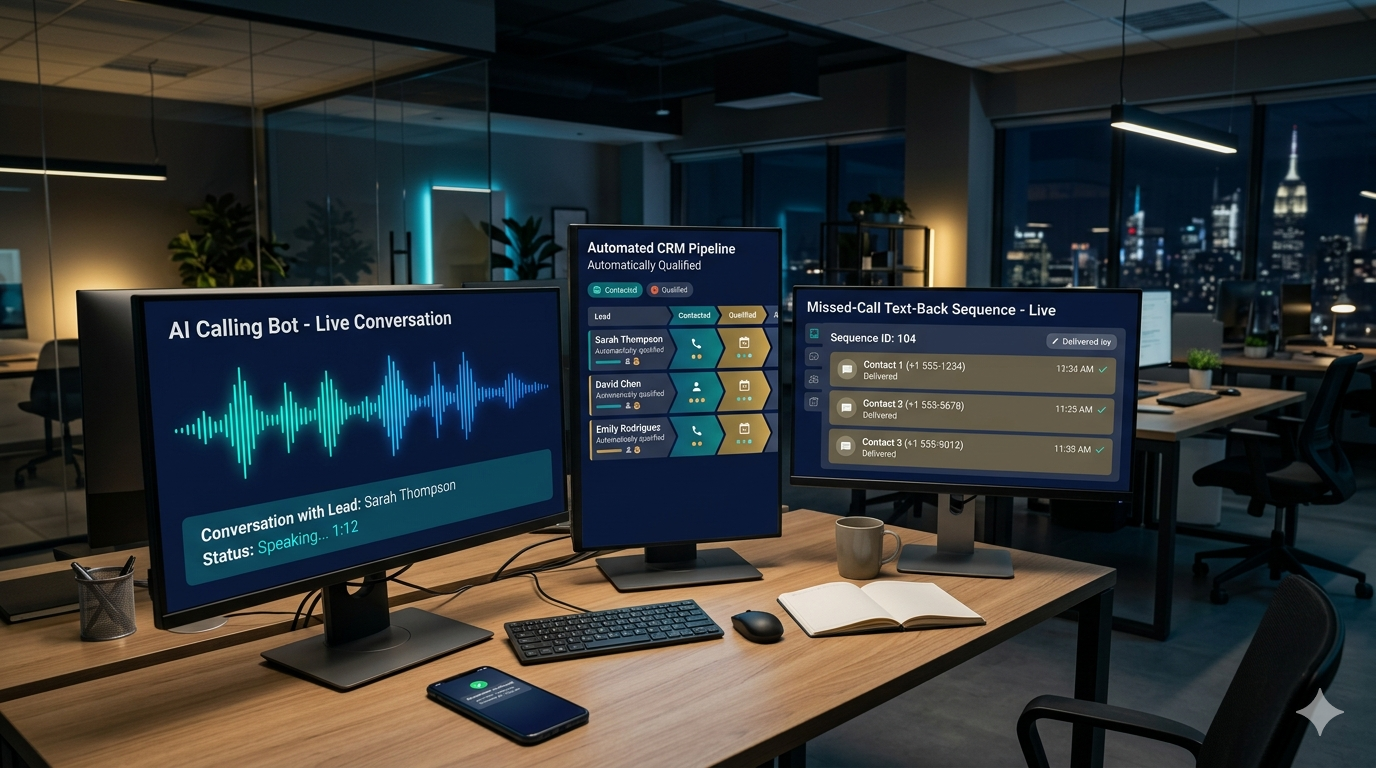
An AI calling bot changes this equation entirely. When a call goes unanswered, the AI system calls the prospect back within seconds — conducting a natural, conversational interaction that qualifies the lead, answers basic questions, gathers the information the team needs, and either books an appointment or routes the conversation to a human team member at the appropriate point.
The same AI calling capability can be deployed outbound — conducting initial outreach calls to a list of warm leads, qualifying them through a structured conversational flow, and delivering only the qualified, interested prospects to the human sales team. This dramatically increases the efficiency of the outbound sales process — because every conversation the human team has has already been pre-qualified by the AI system.
The result is a business that is effectively always available for sales conversations — regardless of the hour, the day, or the current capacity of the human team.
Missed-Call Text-Back — The Lead Recovery System Every Business Needs
The data on lead response time is unambiguous: the probability of converting a lead drops precipitously with every minute that passes between the initial inquiry and the first response. A lead contacted within five minutes of their inquiry is dramatically more likely to convert than one contacted an hour later. A lead contacted the next business day is effectively cold.
The missed-call text-back system solves the most common lead response failure in one step. When a call goes unanswered, the system automatically sends a personalized text message to the caller within seconds — acknowledging the missed call, expressing genuine interest, and inviting a response or a callback. This single automation recovers a significant percentage of leads that would otherwise be lost to the response gap — converting a missed call from a dead end into the beginning of a conversation.
For businesses that receive significant inbound call volume, missed-call text-back is one of the highest-ROI automations available — because it costs almost nothing to implement and directly recovers revenue that is currently being lost every single day.
Automated Appointment Scheduling — Remove the Friction That Kills Conversions
Scheduling friction is a silent killer of sales conversions. The interested prospect who submits an inquiry, receives a response asking for their availability, sends back three time options, discovers none of them work, proposes alternatives, and finally settles on a time three email exchanges later — that prospect has had multiple opportunities to lose interest, get distracted, or decide the effort is not worth it. A meaningful percentage of them do.
Automated appointment scheduling eliminates this friction entirely. When a lead expresses interest in a consultation, the system sends a direct booking link — a real-time calendar that shows available times and allows the prospect to book immediately, in one click, at a time that works for them. No back-and-forth. No delay. The appointment is confirmed automatically, reminder messages are sent automatically, and the meeting details are populated in the CRM automatically.
The reduction in scheduling friction directly increases the percentage of interested leads that follow through to an actual consultation — because the path from interest to appointment is made as short and frictionless as possible.
Lead Qualification and CRM Automation — A Sales Pipeline That Manages Itself
Every business that generates significant lead volume faces the same challenge: determining which leads are worth prioritizing and ensuring that the right action is taken with every lead at the right time. Without automation, this requires constant manual review — someone checking every new lead, assessing its quality, assigning it to the right team member, updating the CRM, and scheduling the appropriate follow-up. It is time-consuming, it is inconsistent, and it is the source of the majority of leads that fall through the cracks.
AI-powered lead qualification and CRM automation handles this entire process automatically. When a new lead enters the system — through a web form, a phone call, an email, a social media message, or any other channel — the AI system assesses the lead against predefined qualification criteria, assigns a lead score, tags the contact with the appropriate attributes, routes it to the right team member or sequence, and schedules the first follow-up action. All of this happens within seconds of the lead entering the system, without any human involvement.
The result is a CRM that is always current, always accurate, and always actionable — with every lead in the right stage, with the right next action assigned, and with no contacts slipping through the cracks because someone forgot to follow up.
AI Chat Automation — Convert Website Visitors Around the Clock
A website visitor who has a question and cannot find the answer quickly leaves. In most cases, they do not come back. The question they had — about pricing, about availability, about whether the service is right for their situation — was the thing standing between them and taking the next step toward becoming a customer. And in the absence of an immediate answer, they made the decision to look elsewhere.
An AI chat system on the website handles these conversations automatically — responding to visitor questions instantly, guiding prospects toward the right service or offer, qualifying their interest, and converting the conversation into a lead capture or a booking. Unlike static FAQ pages, the chat system responds to the specific question being asked, in a conversational format, at any hour of the day or night.
The same chat automation can be deployed across SMS — allowing prospects to text the business directly and receive immediate, intelligent responses that keep the conversation moving toward conversion without requiring a human team member to be available.
The Numbers Behind AI Automation’s Business Impact
The performance impact of AI automation on business operations is not theoretical. It is measurable and it is significant.
Businesses that implement automated lead response systems — responding to inquiries within 60 seconds rather than hours — report lead conversion rate improvements of 30% to 50% or more. The reason is simple: the prospect who receives an immediate, relevant response has not yet had time to contact a competitor. The prospect who waits hours for a response has often already moved on.
Automated appointment scheduling reduces no-show rates significantly — because automated reminder sequences ensure that confirmed appointments stay confirmed. The prospect who booked an appointment and received no follow-up communication between booking and appointment day is far more likely to forget or deprioritize it than one who received a confirmation, a 48-hour reminder, and a same-day reminder — all sent automatically.
AI calling bots deployed for outbound lead qualification routinely achieve contact rates that human outbound teams cannot match at scale — because the AI system can make simultaneous calls across a large lead list without fatigue, inconsistency, or the natural reluctance that human callers experience with high-volume outbound work.
And the operational efficiency gains from CRM automation — eliminating the manual data entry, lead routing, and follow-up scheduling that consume significant administrative time in most businesses — compound over months and years into meaningful reductions in the human capacity required to manage the same volume of leads and customers.
What AI Automation Is Not
Clarity about what AI automation does not do is as important as clarity about what it does — because unrealistic expectations lead to poor implementation decisions.
AI automation does not replace the human relationships that close high-value deals. For complex, high-consideration purchases — where the customer needs to trust the specific person they are working with, where nuanced problem-solving is required, where relationship depth is a significant component of the value being purchased — human sales and service capability remains essential. AI automation handles the volume, the repetition, and the time-sensitive initial response work that would otherwise consume the human team’s capacity. It frees human attention for the high-value conversations where human judgment, empathy, and expertise create outcomes that no automated system can replicate.
AI automation does not compensate for a weak offer, poor positioning, or a product or service that does not deliver genuine value. Automation makes a good business more efficient. It does not make a bad business good. If the underlying offer is not compelling, faster response times and smoother scheduling will not change the conversion math in any meaningful way.
And AI automation does not run itself without strategy and oversight. The qualification criteria, the conversation flows, the response scripts, the routing logic, and the performance metrics all require human design, ongoing monitoring, and continuous refinement. Automation that is set up and forgotten drifts — it produces inconsistent results, misses edge cases, and eventually creates friction rather than removing it.
How King Mills Enterprises Implements AI Automation
King Mills Enterprises builds and implements AI automation systems as part of its comprehensive marketing and business growth service offering — designing, configuring, and integrating the specific automation tools that match each client’s business model, sales process, and growth objectives.
The implementation begins with a process audit — understanding exactly where the current lead and customer management process has gaps, delays, and friction points that automation can address. From that understanding, the right combination of AI tools is selected and configured: the calling bot parameters, the missed-call text-back sequences, the appointment scheduling integration, the lead qualification criteria, the CRM automation workflows, and the chat system conversation flows.
Every automation is integrated with the broader marketing system — connected to the CRM, synchronized with the email and SMS marketing platform, and feeding into the analytics infrastructure that measures performance and enables continuous optimization. The result is not a collection of disconnected automation tools but a unified, intelligent system that handles the full lead and customer management workflow from first contact through conversion and beyond.
King Mills Enterprises provides the ongoing monitoring and optimization support that keeps the system performing at its highest level — adjusting qualification criteria as the business evolves, refining conversation flows based on performance data, and identifying new automation opportunities as the business grows.
Final Thoughts
The businesses that move on AI automation now are building an operational advantage that will be genuinely difficult for their competitors to close once it is established. Every month of automated lead response, qualification, and nurture is a month of compounding conversion data, refined system performance, and customer relationships built faster and more efficiently than the competition can match manually.
This is not about replacing your team. It is about making your team’s capacity go further — by handling the volume, the repetition, and the time-sensitive work that consumes human attention without requiring human judgment, and freeing your people for the high-value work that actually requires them.
The technology is accessible. The implementation is not as complex as most businesses assume. And the results — in lead conversion rates, in response times, in sales pipeline clarity, and in the sheer number of opportunities that get followed up rather than falling through the cracks — are immediate and measurable.
Your competitors are already deciding. Make yours.
To implement AI automation systems that generate leads and convert customers around the clock, visit kingmillsenterprises.com, email info@kingmillsenterprises.com, or call +1 (877) 834-8334.