


Introduction
Think about the last customer your business won. Before they bought from you, before they signed the contract or made the purchase, they went on a journey. Maybe they discovered you through a search, a referral, a social media post, or an ad. Maybe they visited your website, read some content, checked your reviews, and then went away to think about it. Maybe they came back a week later, downloaded something, got an email from you, had a conversation, and eventually made the decision that you were the right choice.
That journey happened whether you designed it or not. Every customer makes that journey. The question is whether your business is actively guiding them through it — or whether you are leaving it entirely to chance, hoping that the people who discover you will somehow find their way to becoming customers without any deliberate structure helping them get there.
The businesses that grow predictably, that scale their customer acquisition with confidence, that know where their next sale is coming from — those businesses have answered that question by building a marketing funnel. Not as a theoretical concept. As a living, operational system that takes a stranger at the top and delivers a loyal customer at the bottom, with intentional design at every stage of the journey between.
This is one of the most transformative ideas in business marketing. Not because it is complicated — it is not. But because once you see your business through the lens of the funnel, you can never unsee it. Every gap in your growth, every inconsistency in your customer acquisition, every moment where a prospect went quiet and never came back — all of it becomes visible, diagnosable, and fixable. And that visibility is the beginning of a fundamentally different level of business performance.
What a Marketing Funnel Is
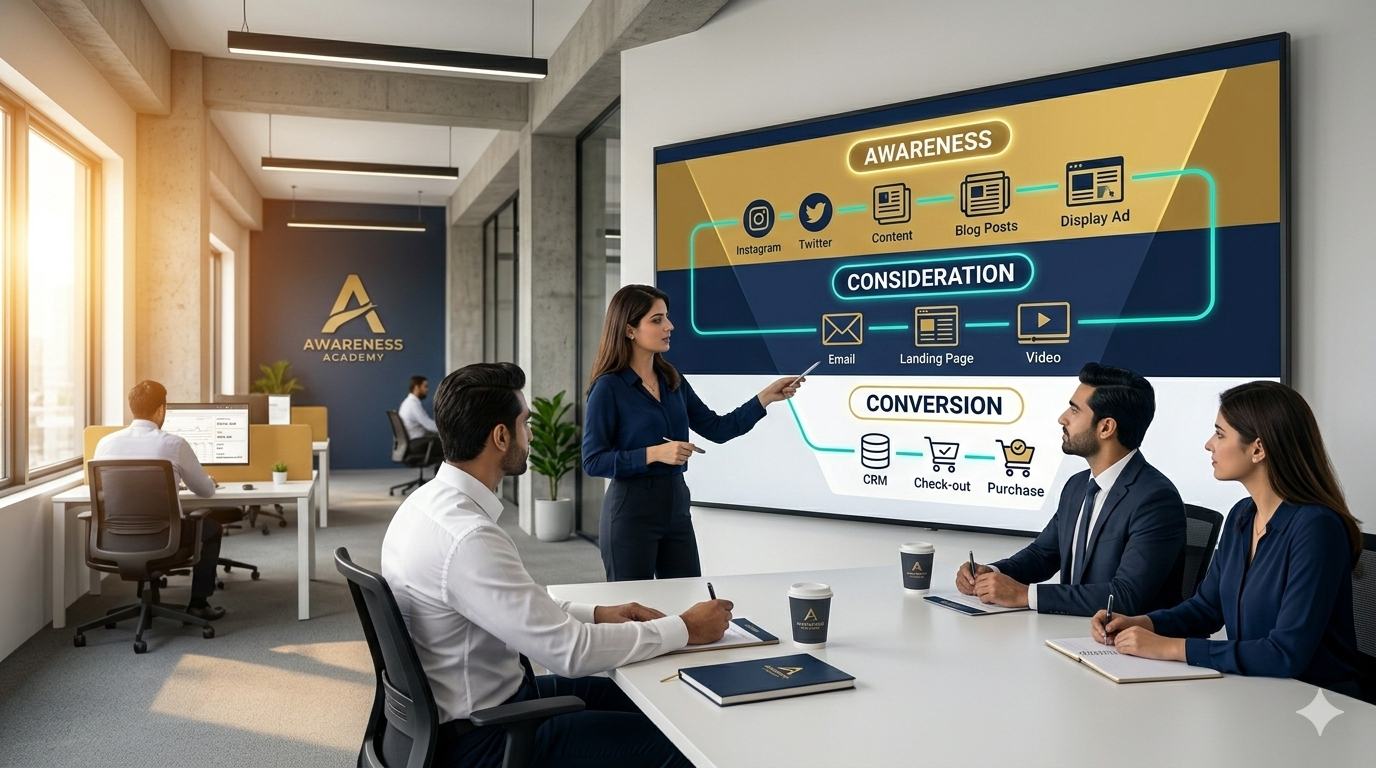
A marketing funnel is a model that maps the journey a customer takes from the first moment they become aware of your business to the moment they make a purchase — and beyond. It is called a funnel because at each stage of the journey, the pool of people gets smaller: many people become aware of your business, fewer actively consider it, fewer still make an inquiry, and fewer again become paying customers. The funnel shape captures this natural narrowing.
But the power of the funnel is not in the metaphor. It is in what the model makes possible: a clear understanding of what needs to happen at each stage of the customer journey, what marketing activity drives movement from one stage to the next, and where the gaps are that are costing your business customers and revenue it should be capturing.
The funnel is typically organized into three primary zones, each with a distinct objective and a distinct set of marketing activities designed to serve it.
The Top of the Funnel — Awareness. This is where strangers become prospects. At this stage, your marketing objective is simple: put your business in front of the right people who do not yet know you exist. Top-of-funnel marketing is about reach and relevance — reaching the people most likely to benefit from what you offer and making a strong enough first impression that they want to learn more. Social media content, paid advertising, SEO-driven blog content, podcast appearances, and referral networks all operate at the top of the funnel. The measure of success at this stage is not sales — it is awareness. Are you reaching the right people? Are they stopping to pay attention?
The Middle of the Funnel — Consideration. This is where prospects become genuinely interested. They know who you are. Now they are evaluating whether you are the right choice for their specific need. At this stage, your marketing objective shifts from reaching to persuading — building the trust, credibility, and desire that move a prospect from “I know about this business” to “I want to work with this business.” Email nurture sequences, case studies, testimonials, educational content, webinars, consultation offers, and retargeting campaigns all operate in the middle of the funnel. The measure of success here is engagement — are prospects spending time with your content, returning to your website, responding to your emails, and progressing toward a decision?
The Bottom of the Funnel — Conversion. This is where interested prospects become paying customers. At this stage, your marketing objective is to make the decision to buy as clear, confident, and frictionless as possible. Conversion-focused landing pages, compelling offers, strong calls to action, risk-reducing guarantees, and responsive sales follow-up all operate at the bottom of the funnel. The measure of success here is the one that matters most: revenue. Are prospects converting into customers at a rate that makes the investment in the top and middle of the funnel worthwhile?
Why Most Businesses Are Missing Most of Their Funnel
Here is what is true of the vast majority of businesses operating without a deliberately built marketing funnel: they are not missing the entire funnel. They typically have some version of the bottom. They have a way for people to buy, a product or service to sell, and some mechanism for taking payment. What they are missing is everything that brings people to the bottom.
A business without a top-of-funnel strategy is invisible to the people who have never heard of it. It relies entirely on word of mouth, repeat business, and the occasional person who happens to search exactly the right thing and finds the website. Growth is slow, unpredictable, and dependent on conditions outside the business’s control.
A business without a middle-of-funnel strategy loses the majority of the prospects it does reach. People visit the website, see an ad, or hear about the business — and then nothing happens to develop that initial awareness into genuine interest and intent. The prospect goes cold. The opportunity evaporates. And the business never knows it happened because there is no system tracking where prospects are in their journey or what would move them forward.
The result is a business that feels perpetually dependent on getting lucky — on the right person discovering it at exactly the right moment when they are already ready to buy. That dependency is the ceiling that prevents predictable growth. And it is entirely removable when the full funnel is built.
The Funnel Is Not Just for Getting New Customers
One of the most powerful and most underappreciated dimensions of the marketing funnel model is what happens after the conversion — and how the funnel, extended beyond the initial sale, becomes the engine of customer lifetime value, retention, and referral.
A customer who has purchased from you is not at the end of the funnel. They are at the beginning of the most valuable relationship your business can cultivate. The businesses that grow most powerfully over time are the ones that invest as much strategic intelligence in what happens after the first sale as they do in generating it.
Post-conversion marketing — the onboarding sequences that make new customers feel welcomed and confident, the follow-up communications that ensure satisfaction and identify opportunities for additional value, the loyalty and referral programs that turn happy customers into advocates — is the part of the funnel that converts a single transaction into a lasting relationship. And lasting relationships are the most efficient source of revenue in any business: they cost less to maintain than new customers cost to acquire, they generate higher lifetime value, and they produce referrals that bring new prospects into the top of the funnel at zero acquisition cost.
Building the full funnel — from awareness through conversion and into post-purchase relationship development — is building a customer acquisition and retention engine that compounds in efficiency and output over time. Every happy customer who refers another person adds a new strand to the top of the funnel. Every retained customer who purchases again improves the lifetime value calculation that justifies investment in acquisition. The funnel is not a linear path to a single sale. It is a circular system that feeds itself.
The Seven Elements of a High-Performing Marketing Funnel
Understanding the funnel conceptually is one thing. Building one that actually performs is another — and it requires seven specific elements, each of which plays a distinct role in the system’s overall function.
A clearly defined ideal customer. The funnel only works if it is designed for a specific person. Who is your ideal customer? What are their specific pain points, desires, fears, and aspirations? What language do they use to describe their problem? Where do they spend their time online? What kind of content do they engage with? A funnel built around a vague, generic customer profile will generate vague, generic results. A funnel built around a precise, research-based ideal customer will speak directly to the people most likely to become your best customers — and they will feel it.
Compelling top-of-funnel content and campaigns. The awareness stage requires consistent, strategic marketing activity — content that reaches your ideal customer where they are, earns their attention, and creates enough genuine interest that they want to know more. This might be social media content, paid advertising, SEO-optimized blog posts, video content, or any combination of channels that effectively reaches your specific audience. Whatever the channel mix, the content must be worth the attention it asks for.
A lead capture mechanism. At some point in the top of the funnel, the goal is to move an interested prospect from an audience member — someone who has seen your content — to a known contact whose journey you can actively develop. This typically happens through a lead magnet: a valuable resource, tool, or experience that the prospect receives in exchange for their contact information. The lead magnet is the bridge between awareness and the nurture relationship — and its quality directly determines the quality of the leads it captures.
A nurture sequence that builds trust over time. Once a prospect is a known contact, the middle of the funnel is where the relationship is developed. A well-crafted email nurture sequence — a series of purposeful, value-rich communications delivered over days and weeks — is the most reliable mechanism for building the trust and credibility that move a prospect from interested to ready. Each email in the sequence should deliver genuine value, address a specific dimension of the prospect’s consideration, and progressively build the case for why your business is the right choice.
A conversion-optimized destination. When a prospect is ready to take the next step — to inquire, to book a consultation, to make a purchase — the destination they arrive at must be designed to make that step as clear and frictionless as possible. A high-converting landing page or product page, with a strong headline, compelling offer, relevant social proof, and a single clear call to action, is the mechanism that turns intent into action. Every element of this page should serve the single objective of completing the conversion.
Tracking and analytics infrastructure. A marketing funnel that cannot be measured cannot be improved. Every stage of the funnel — from initial awareness through conversion — should be tracked with the precision that enables intelligent optimization. Where are prospects entering the funnel? Where are they dropping off? Which content is driving the most engagement? Which nurture emails are generating the most conversions? Which landing page variations are outperforming? The answers to these questions, available through proper analytics infrastructure, are the roadmap to continuously improving funnel performance.
Post-conversion relationship systems. The onboarding experience, the follow-up sequences, the referral mechanisms, and the retention marketing that extends the customer relationship beyond the initial sale — these are the elements that transform a one-time customer into a long-term asset and an advocate who actively feeds new prospects into the top of the funnel.
What Becomes Possible When the Funnel Is Built
This is the part that should inspire every business owner who has ever felt that their growth was inconsistent, unpredictable, or dependent on factors outside their control.
When a marketing funnel is properly built and operating — when all seven elements are in place and working together — something fundamental changes about how the business grows. Growth stops being a matter of luck and starts being a matter of system performance. The question stops being “will we get enough customers this month?” and becomes “how do we optimize the system to get more?”
You can see exactly where prospects are in their journey. You can identify the specific stages where they are dropping off and make targeted improvements that move the needle. You can forecast revenue with greater confidence because you understand the conversion rates at each stage of the funnel and the volume of prospects entering the top. You can scale your investment in the channels that are performing — because you have the tracking to know which ones those are — and reallocate from the ones that are not.
You wake up to a CRM that shows you fifty warm prospects in various stages of consideration, a nurture sequence that delivered value to all of them while you were sleeping, and three new inquiry forms submitted from leads who read a blog post, downloaded a guide, and decided you were exactly the right choice. That is not a fantasy. That is what a functioning marketing funnel produces — reliably, predictably, and at scale.
The businesses achieving that kind of predictable growth are not bigger than you. They are not smarter than you. They have simply built the system that makes it possible. And you can build it too.
How King Mills Enterprises Builds Your Complete Marketing Funnel
This is exactly what King Mills Enterprises does — not as a single service, but as an integrated, end-to-end system built around your specific business, your specific ideal customer, and your specific growth objectives.
The process begins with strategy: defining the ideal customer profile with precision, mapping the customer journey, identifying the highest-leverage opportunities at each funnel stage, and designing the system architecture that will connect every element into a coherent whole. This strategic foundation is what separates a marketing funnel that performs from a collection of disconnected tactics that merely create activity.
From that foundation, King Mills builds every component the funnel requires: the paid advertising and content marketing that drives top-of-funnel awareness, the lead magnets and landing pages that convert awareness into captured contacts, the email and SMS nurture sequences that develop those contacts into ready buyers, the conversion-focused pages and offers that close the sale, and the post-conversion systems that develop first-time buyers into long-term relationships and referral sources. All of it tracked, measured, and continuously optimized through the analytics infrastructure that makes intelligent improvement possible.
With 19+ marketing services operating as a unified system, 100+ clients served, and a 5x average ROI, King Mills Enterprises brings the strategic depth, the execution capability, and the proven results framework to build a marketing funnel that transforms how your business grows.
Final Thoughts
Every business is already in the funnel business — whether they know it or not. Every customer who has ever chosen you followed a journey to get there. Every prospect who discovered you and disappeared was lost somewhere in a funnel that had no structure to catch and develop them.
The question is not whether your business needs a marketing funnel. It already has one — incomplete, undesigned, and leaving an enormous amount of potential revenue on the table. The question is whether you are ready to build it with the intention, the structure, and the strategic intelligence it deserves.
Because when you do, everything changes. Growth becomes predictable. Customer acquisition becomes a system you can optimize rather than a mystery you hope works out. And the business you have been working so hard to build finally has the engine it needs to grow at the pace you have always known it was capable of.
Your funnel is waiting to be built. The customers it will deliver are waiting to be found. The growth it will generate is closer than you think.
To build a complete marketing funnel that transforms how your business grows, visit kingmillsenterprises.com, email info@kingmillsenterprises.com, or call +1 (877) 834-8334.